Monday, 20 July 2015

How Viruses work in Computer


Virus - Strange as it may sound, the computer virus is something of an Information Age marvel. On one hand, viruses show us how vulnerable we are -- a properly engineered virus can have a devastating effect, disrupting productivity and doing billions of dollars in damages. On the other hand, they show us how sophisticated and interconnected human beings have become.
For example, experts estimate that the Mydoom worm infected approximately a quarter-million computers in a single day in January 2004. Back in March 1999, the Melissa virus was so powerful that it forced Microsoft and a number of other very large companies to completely turn off their e-mail systems until the virus could be contained. The ILOVEYOU virus in 2000 had a similarly devastating effect. In January 2007, a worm called Storm appeared -- by October, experts believed up to 50 million computers were infected. That's pretty impressive when you consider that many viruses are incredibly simple.
When you listen to the news, you hear about many different forms of electronic infection. The most common are:

Viruses: A virus is a small piece of software that piggybacks on real programs. For example, a virus might attach itself to a program such as a spreadsheet program. Each time the spreadsheet program runs, the virus runs, too, and it has the chance to reproduce (by attaching to other programs) or wreak havoc.

E-mail viruses: An e-mail virus travels as an attachment to e-mail messages, and usually replicates itself by automatically mailing itself to dozens of people in the victim's e-mail address book. Some e-mail viruses don't even require a double-click -- they launch when you view the infected message in the preview pane of your e-mail software [source: Johnson].

Trojan horses: A Trojan horse is simply a computer program. The program claims to do one thing (it may claim to be a game) but instead does damage when you run it (it may erase your hard disk). Trojan horses have no way to replicate automatically.

Worms: A worm is a small piece of software that uses computer networks and security holes to replicate itself. A copy of the worm scans the network for another machine that has a specific security hole. It copies itself to the new machine using the security hole, and then starts replicating from there, as well.


                                 " Let's talk more about this in next article"

Wednesday, 24 June 2015

iOS 9 - A room for Update


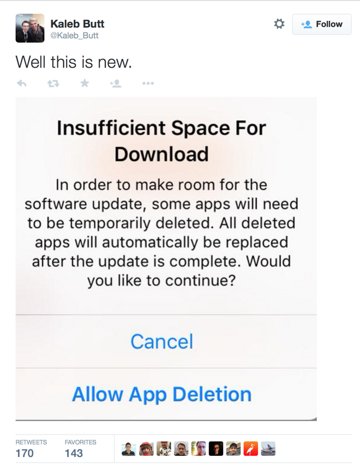
Developers running the first beta of iOS 9 on devices with limited free space were greeted with a new dialog informing them that their device has insufficient space to download the update, while offering the option to "Allow App Deletion." The dialog says that any apps deleted will automatically be replaced once the update is complete.


Users can choose to let iOS decide which apps to delete, or cancel the download and manage the space on their device manually. 


Apple has taken a number of steps to make upgrading easier for users in iOS 9. In addition to automatic app deletion, the company will allow overnight updates that will be carried out while users don't need their device.


Apple has also reduced the amount of free space required to install updates on the device, from 4.6 gigabytes for iOS 8 to 1.3 gigabytes for iOS 9.


First announced during Apple's Worldwide Developers Conference earlier this month, iOS 9 brings long-awaited updates for Siri, iPad multitasking, and a host of other updates and changes. It's currently available to developers in beta form, and will likely ship alongside the next-generation iPhone later this fall.

Tuesday, 4 November 2014

The Use and Abuse of Technology in the Classroom


More and more primary teachers now have access to technology in their classroom. Whether it is an iPad or an iPod touch, a desktop or a laptop, a growing number of teachers are either being given access to this technology by their school boards or bringing their own devices to class to help students to learn. Because of the multitude of choices and opportunities that technology enables, this is a positive development.

I have been concerned, though, by some of the ways that I see technology being used. Technology should not just allow us to do things in a more engaging way; it should allow us to do new things that we thought were not possible. It is those new things that are the real value technology provides.  It is not enough to USE technology. You must use it well.

Having access to books does not mean that the students in my classroom will learn to read. I need to make careful pedagogical choices and use those books in a way that will gently and purposefully help those children to become independent readers. Very few children can make this leap themselves. Most need a thoughtful teacher to guide them.

In the same way, having technology in my classroom does not mean that my students will discover how to use it as a learning tool. I have to carefully select and structure what it is used for so that it becomes truly educational. As with reading books, should not our goal be to develop independent learners? Here are my personal abuse and use lists for the handling of devices in the classroom.

Technology Abuses

Technology should not be used as simply a digital worksheet. There are many apps and Internet sites available that are simply a technological version of a paper task, forcing students to practice over and over a skill that they may already have mastered.  Don’t get me wrong. Skills do need to be practiced. I just happen to think that students should spend most of their time using technology for more creative purposes.

Technology should not be used as a way to keep students occupied.  A small number of computers or devices in a classroom can be an inviting center, whether it is an assigned or a self-chosen one.  If you use technology in this way, choose wisely when you decide what the students will do with the technology. There are many, many creative options available. It should not be just to keep students busy while you work with small groups of children. (They’re working on mouse skills? Really?)

Technology should not be used to do what can be done without it.  Drawing a picture on an app or a computer program and labeling it is a worthwhile activity, but why bother if that activity is an end in itself? It may as well have been done on paper. Technology should allow you to do something new with that picture, such as sharing/publishing it in some way.

The good news is that there are other, better options for using technology. My heart does a happy dance when I see these.

Technology Uses

Technology should be for accessing what was inaccessible. In the past, my teaching materials were limited to what was in my classroom and in the school’s library. Now there are a plethora of materials available online to fill any teaching need I have, limited only by my online search skills. From classroom-ready videos such as those of Mercer Mayer and Dr. Jean to sharing and learning with other teachers on Pinterest or Twitter to accessing the creative commons photos of thousands of photographers—well, let’s just say there is no longer an excuse for not having appropriate resources.


Technology should be for doing good things in better ways. For example, hearing books being read aloud is an important part of primary literacy.  Long ago, listening to books on a cassette tape became listening to books on a CD. Now, there are online books and apps that do a much better job of this, highlighting the words as they are read aloud.

Technology should be for sharing with the world.  The environment that our students are growing up in is wired for sharing. The hardware and the software that is available make it easier every day for children to share what they are learning with the world. Even young children can share their learning using drawings, images, blogs, video and digital portfolios. By sharing their artifacts digitally, students invite the involvement and support of their parents, grandparents and anyone who sees their work.

Technology should be for connecting. Before the advent of the Internet, classrooms were forced to be isolated learning hives.   Now, those hives can all be interconnected as classrooms can easily link with other classrooms and experts to ask questions, compare experiences and learn together. Tools such as Skype, Twitter and blogs make connecting and collaborating with classrooms from anywhere a possibility.

Technology should give choices.  We are blessed to have a lot of technology in my classroom and my favorite part of that is the choice it gives my students in both their learning style and in sharing what they have learned. When allowed to choose, some students prefer to read on iPad or computers. Others choose paper books.  I think choice is important as we accommodate the variety of needs our learners have.

Technology should not just allow us to do traditional in a different way; it should allow us to do things that we thought were not possible.

Friday, 10 October 2014

Technology: Good or Bad for Today’s Youth?


“Don’t text my heart” these word of wisdom were spoken to by the Christian writer Chad Estham, but what do these words mean? The youth today are becoming more and more attached to their technology. Relationships are being built online or through phones. Keyboards and keypads are becoming the keys to our heart. Technology provides a way of communication but is becoming the only way to communicate with today’s youth because it has made one on one interaction less frequent and has made a negative effect on the social abilities of the youth.
Technology is a great way to stay entertained but it is disconnecting people. Today’s Internet users have many ways to be occupied online. These days we have the ability to communicate on websites like facebook, ways to watch TV shows and clips mostly on YouTube, and play entertaining games like on addictinggames, all while on the computer. And we wonder why we have no in person friendships and dysfunctional families. Non-internet users spend 12.6 more minutes on average doing social activities, such as parties, sporting events, and person-to-person conversations (Nie and Hillygus). Internet users spend 34.3 minutes less than non-internet users with family and friends (Nie and Hilygus). Those who don’t switch off the computer, switches off all personal relationships with family and friends. 
Technology like iPods and cell phones make a personal bubble and make it portable. Cell phones create a distraction from real life experiences and because of their ability to be taken anywhere, I see teens texting anywhere they can. Teens text while talking to someone else, at the dinner table, in the car if driving or not,at he movies, and worst of all in church. This tiny piece of plastic is distracting teens from the most important message of all. The message of God. iPods also create the distraction but it also sends a signal “visible from a good distance away, white earphones signal one thing to most people: don’t bother trying to talk to me” (Song). This action irritates people. I have a friend and whenever we get in the car she sticks her headphones in and I endure the rest of the car ride in silence. I find it rude. These bubbles are growing around so many people and someone just needs to pop them.
As you can tell, I am very much against technology but there are ways that is helps. It helps many people stay in touch with friends that might have moved away, “the internet can make it easier to keep in touch with old friends” (Coget and Ytaka). In my life, I will move on from all my friends and I will still want to stay in touch with them all, but it can be just as easy to look them up and ask if they would like to do something in person. Staying in touch can be done in person as much as over technology.
Some people have trouble making new friends and the internet provides ways to meet new people through chat rooms. I believe relationships built online can be a little eccentric but, “one study suggests that online relationships simply take longer to develop than those face-to-face and eventually can become as rich” (Coget and Yutaka). Online relationships can be dangerous because you never know who’s on the other side of the chat.
You can become more open over the internet if you don’t have a chance to meet others in real life. Meeting people online can give you confidence in who you are, but I believe it also tears you down. Knowing that you din’t have real frinds and resorting to making them online can make you feel worthless. Online relationships will either build you up or break you down. 
“Data showed that as people in this sample used the internet more, theyreported keeping up with fewer friends,” so keep your friends (Affonso). Don’t be sucked into the internet and leave others behind. Most importantly, don’t let keypads and keyboards be the key to your heart.

Thursday, 11 September 2014

How ALS Could Benefit from a Flood of New Funding?

A viral social-media campaign has brought unprecedented money to a rare disease. How might new funding help ALS research?

man getting cooler of ice water poured over his head with onlookers

Friends for this moment lets forget the Technology. Because I thought of presenting you a word/line that is resounding in any of the Social Sites i.e.., ALS ice-bucket challenge. This post tells you what's ALS? Why the challenge and all.

It’s no surprise that social-media campaigns can raise awareness of an issue, but the ALS Ice Bucket Challenge may be unprecedented in its impact on a relatively rare disease. The campaign, in which participants must donate to an ALS cause or take videos of themselves being doused in ice, has gone viral since it began in late June. But it has also generated controversy, with some questioning the attention and flood of cash for a disease that affects a small number of people.

As of Friday, the ALS Association had received $53.3 million since July 29, compared with $2.2 million by that time last year. To put it in perspective, the National Institutes of Health’s yearly budget for ALS research is $40 million. Other ALS charities are also benefitting similarly from the campaign.

All of this could be a big boost for ALS research. ALS (amyotrophic lateral sclerosis, also called Lou Gehrig’s disease) is a devastating and ultimately fatal disease that causes deterioration and death of the movement-controlling nerve cells in the brain, brain stem, and spinal cord. It usually progresses rapidly and becomes fatal when a person loses the ability to swallow or breathe.

So far, the ALS Association, which has received the bulk of donations, has not announced how the Ice Bucket Challenge money will be directed or how much will go specifically to research. But the influx of cash could have a big impact on a disease that’s been frustratingly hard to comprehend or treat.

In spite of progress toward understanding the disease, there’s no known cure, and treatments are limited. Here are some of the key problems that ALS researchers are investigating—areas that could benefit from extra funding.

Who gets ALS?

While some people get ALS because they inherit a mutation in one of more than a dozen genes that studies have linked to the disease, 90 percent of those affected have no known risk factors. In the past few years, however, a lot of progress has been made in studying the genetics of ALS, which could help pinpoint the underlying mechanisms of the disease and find possible drug targets. In 2011, for instance, researchers discovered that repetition of DNA sequences in a gene called C9ORF72 is the most common cause of familial ALS and also contributes to noninherited cases of the disease. A wave of new research is now exploring the roles of this gene in greater detail.

What causes the damage that characterizes ALS?

There are still many theories that have not attracted a clear consensus. One of the leading areas of research has to do with abnormalities in RNA molecules and the buildup of proteins in cells. But it may be that a combination of other factors is also to blame.

Why are the effects of ALS so variable?

Some people with ALS have damage only to motor neurons, so their minds remain sharp even as their ability to control their bodies deteriorates. Others experience cognitive problems and dementia. The pace of progression also varies widely. Physicist Stephen Hawking, who was diagnosed with ALS at age 21 and is now in his early 70s, is an outlier. Most people develop the disease later in life and die within three to five years of diagnosis. A major research effort is under way to understand the differences underlying distinct ALS types. The ALS Therapy Development Institute in Cambridge, Massachusetts, has announced that it will direct its Ice Bucket Challenge money to a new sample collection effort that will study 100 ALS patients in unprecedented depth—sequencing their genomes, profiling their clinical history, using accelerometers to study their movements, and creating stem cells from their skin samples. The goal will be to develop therapies tailored to specific ALS subgroups.

What are the challenges involved in developing ALS treatments?

Because ALS is designated as an “orphan” disease (affecting fewer than 200,000 people in the United States), potential treatments have fewer hurdles to pass on their way to FDA approval. But it’s challenging to recruit patients for trials when there’s such a small pool to begin with. What’s more, many drugs that have seemed promising in laboratory research failed in clinical trials, so leaders of the ALS Therapy Development Institute say that scientists need to get smarter and more rigorous in how they conduct studies.

One option is to use cells from ALS patients rather than animals to screen for drugs. Researchers at the Harvard Stem Cell Institute are testing potential therapies in the lab using induced pluripotent stem cells from ALS patients—skin cells that have been transformed into stem cells and then coaxed to become neurons. They recently identified a drug approved for epilepsy that might help; it is now being tested in ALS patients.

Saturday, 23 August 2014

Science, Technology and Society


Technology and society or technology and culture refers to cyclical co-dependence, co-influence, co-production of technology and society upon the other (technology upon culture, and vice-versa). This synergistic relationship occurred from the dawn of humankind, with the invention of simple tools and continues into modern technologies such as the printing press and computers. The academic discipline studying the impacts of science, technology, and society and vice versa is called (and can be found at) Science and technology studies.

The development in modern cellular phone technology, like increasing speed of phone processors, the use of touch-enabled screens, and the implementation of mobile internet access, are further examples of the cycle of co-production. Society's desire for widespread, frequent, and easy access to communication lead to the research and development of an ever widening array of mobile phone capabilities. Access to these capabilities, in turn, influenced the way humans live. As the populace relies more and more on mobile phones, additional features were requested.

Society also influenced changes to previous generation media players. In the first personal music players, cassettes stored music. However, that method seemed fragile and relatively low fidelity when compact disks came along. Later, availability of MP3 and other compact file formats made compact disks seem too large and limited, so manufactures created MP3 players which are small and hold large amount of data. Societal preferences helped determined the course of events through predictable preferences.

Tuesday, 19 August 2014

Problems with Technology in Education


       Technology has been used in most schools since the 90's (remember CD-ROM S?), but it still has some hiccups.  We weigh in on some of the most problematic issues facing the ed tech world today.

The crutch

        Students are so quick to turn to the Internet to answer questions that some believe critical thinking has gone down the tube.  Spelling is no longer something tested if everything is auto corrected and spell checked.  This may be a larger issue of technology on our memory and brain-strength, but if we are using the Internet in schools, then kids are being taught to use Google to answer all their questions and to essentially, copy and paste their knowledge.  Education needs to figure out how to use technology in a way that does n’t replace knowledge, but reinforces it.

The crash

Before it was the dog ate the homework, now it’s the computer crashed and “It was all done before it got erased!”  But, this popular excuse is used because it does happen.  When using the computer and all its glitches to create a project that requires hours of work, it sometimes gets erased, does n’t transfer over correctly, does n’t save, or for one human error or another is gone.  Many technology rookies have been in this position and curse at the computer that has stolen hours.  Some students struggle simply to complete work that it seems unfair to put obstacles in their way, especially when some students may not have programs or the technology at home to become familiar with it.  The problem with technology glitches is also seen with online textbooks.  Some students have issues accessing textbooks at home if they don’t have a large enough bandwidth. Other access problems to online materials can delay students and put them behind in class.

The old-timer

           Some teachers do not utilize the technology they’ve been given.  They have been teaching for years and don’t want to incorporate something new into their time-tested lesson plans.  Some schools are pushing instructors to incorporate technology into their syllabi and when it is poorly taught the technology is not used at optimal level.  Any teacher given high-tech programs and expected to teach it in the classroom deserves proper training, and sometimes it isn’t provided.

The Facebook

            And Twitter, Instagram, Pinterest, YouTube, etcetera.  Putting a computer in front of a high school student and expecting them NOT to go on Facebook or any other distracting non-school related site is kind of a joke.  And it is n’t just the younger students that are in danger of losing focus; even graduate students can hardly help themselves to online distractions in the classroom.  When keeping students excited and focused on the lesson at hand is one of the hardest task a teacher faces, a computer can be one of the most detrimental things to that student’s learning.

The Band-Aid

        The idea that technology can save education may have some truth in it, but it may be problematic to treat all our educational issues with technology. In 2007, Education Week reported on a major federal study  that found, “no difference in academic achievement between students who used the technology in their classrooms and youngsters who used other methods.”  If students are n’t proficient in their studies to begin with and technology is used incorrectly, a whole mess of problems could arise.  What’s wrong with the Band-Aid thinking is that technology needs to be planned out into schools in a very precise manner in order for it to be effective, and to cover all of education’s problems in a Band-Aid may further aggravate the issues.